Our History
Barrett is a well known Irish clan which includes various septs including MacPadine, MacWattin, MacEvilly (Mac an
Mhileadha), and MacAndrew. There are two Barrett clans in Ireland which
were believed to be unrelated before recent research proved otherwise.
They are Norman in
origin, and trace their ancestry to a John Baret who came over from
France with William the Conquerer in 1066. The name Baret can be found
in the Roll of Battle Abbey, the monument William erected to honor those
who fought with him at Hastings. They are later mentioned under the name of Baret in the Domesday book of 1086. The Barretts then came to Ireland with the Norman warlord Strongbow (Richard
Le Clare, the Duke of Pembroke) at the end of the twelfth century.
The first branch of the clan are the Munster Barretts of Co. Cork,
and the other is the Barrett clan of Connacht, most numerous in the Mayo-Galway mountain region. This clan
was thought to be Gaelic in origin, although it known that they came to Ireland with the
Norman invasion. They were hired
mercenaries from Wales. To this day, the Barretts and the
Barrys of Connacht are known as "the Welshmen of Tirawley".
The similarity of the names of the two Barrett clans
was thought purely
coincidental. The view prevailed that the Barretts of Cork derived their name from the Norman-French "Barratt," while the Barretts of Connacht
derived their name from the gaelic name "Bairéad" which means quarrelsome or warlike . In fact, many daughters and sons of
the clan, living in Connacht, are still called Bairéad (or mac Bairéad, as the case may be). But
the English pipe rolls of the 13th century clearly indicate that the overlords of both the Cork and the Mayo Barretts were exactly the same people, and the records further indicate that both families came from Pendyne in Wales.
Both branches of the Barrett clans were fully assimilated
into
Irish culture and married into many old Irish families, they are said to have become "more
Irish than the
Irish themselves".
You will find many Barretts/Bairéads in Irish history serving the Irish nation such as Col. John Barrett who
raised a regiment of infantry for King James' army in Ireland, afterwards he and his clan suffered a wrath of genocide and land
confiscations dealt by the Williamite armies in 1691. There was Ríocard Bairéad "The poet of Erris", a prominent United
Irishman; to name a few.
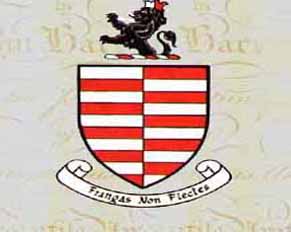
Our Coat of Arms-Have
Sword, Will Travel-
August 22, 1485 on the battlefield of Bosworth in Wales, Henry Tudor
became the King of England. King Henry VII began
one of the most celebrated dynasties in English history, where his son,
Henry VII and his
granddaughter, Elizabeth I, attempted to rebuild England, Ireland and Wales.
Historical sources regarding the actual battle at Bosworth were
practically non-existent. Medieval battles were confusing to describe and
observers were not standing there taking notes.
Another interesting fact about the Battle of Bosworth,
was that Welsh and Irish mercenaries were hired and later knighted by King Henry
VII. The Clan Barrett, from County Cork, was one of those clans. As the
story goes, these clans rode swift Irish ponies and overtook the heavily
armored knights. After the battle was won, the King of England led the
remainder of forces back to Pembroke.
Researching the Clan Barrett further, in 1100 A.D.,
they migrated to Wales
with Strongbow during the Norman Conquest and settled in a county called
Pendyne. Later, they migrated to Munster Ireland, County Cork, and became
known as the Master Lords of Tirawley.
Their motto was: “Frangas non Flectes: virtus
probitas” meaning ‘Unbowed, Unbroken, Honor and Courage.’ Their Coat of
Arms Barry consisted of of ten per pale argent and gules counterchanged. The Crest: A demi-lion rampant sable ducally crowned per pale argent and gules. This
in laymen’s terms was the crowned lion atop a shield striped with red and
white.
Another version of the Barrett coat of arms
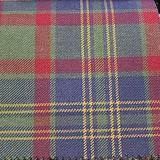
Barrett Clan Tartan
The Poem - The Barretts, along with the Lynotts, are the subject
of the old Irish ballad,
"The Welshmen of
Tirawley The Barretts, like many Normans back then. were
pretty barbaric They did manage to improve a bit, though.
-From Internet sources, and added to by me.
 |